|
 |
 |

|
 |
|
What, Where & How

Education has been a cornerstone of The Center’s mission since our founding over 30 years ago. It’s taken many different shapes and sizes – from webinars, workshops and trainings, to new research, tools, and resources – all designed to support improved outcomes in healthcare environments.
Like The Center, the learning experience has and continues to evolve. What, where and how we learn is impacted by the changing face of healthcare environments, scientific and technological advancements, and new methods and modalities of both teaching and learning.
 To help define and lead the future of how we deliver, scale, and sustain learning across the healthcare design ecosystem, earlier this year The Center hired Beth Bazer, Ed.D., as our new Vice President of Learning and Professional Development.
With a Masters of Arts in Education from Northwestern University, a Doctorate in Educational Leadership from the University of Illinois Chicago, and over 20 years as an educator and senior-level director of educational program design and strategy, we’re fortunate and excited to welcome Beth to our team.
What’s in store for The Center and our community? I asked Beth to share a glimpse into her vision.
“One of our priorities is recognizing that learning needs change over the course of a career. Someone just entering the field has different needs than someone who has been doing this work for 20 years. We want to create opportunities that welcome the next generation of professionals, support those who are building their expertise, and continue to challenge and inspire experienced leaders in the field.
“That means exploring a greater variety of learning formats, more flexible ways to engage, and opportunities for professionals to learn not only from experts but also from one another.
“In the coming year, people can look forward to engaging, relevant, and practical educational experiences, along with new opportunities to deepen their knowledge and connect with the broader community.”
Thanks Beth – and welcome!
Be Well,

Debra Levin, Hon. FASID, EDAC
President and CEO
|
|
WE INVITE YOU
|
|
Space Utilization: What Healthcare Designers Need to Know

December 3, 2026
10:00 AM PT / 1:00 PM ET
Affiliate Discounts Apply
CEUs Available
How effectively healthcare organizations utilize their existing space has significant implications for facility planning, design decisions, capital investments and long-term operational performance.
Join senior facilities executives from leading healthcare organizations as they discuss the real-world challenges they face in optimizing space utilization. Panelists will share perspectives on competing priorities, space management policies and standards, and the data and strategies being used to make better use of existing facilities.
Attendees will gain valuable insight into what healthcare clients are trying to achieve, the trade-offs they must navigate, and how design, construction, and product/solution partners can better support their goals through informed planning and design recommendations.
Learn more and register.
Healthcare Furnishings: Making Decisions for Safety and Longevity
November 19, 2026
9:00 AM PT / 12:00 PM ET
FREE
Join an interdisciplinary panel of experts in research, design, manufacturing and healthcare facilities as they explore tools for making furniture and fabric decisions that balance performance, safety and aesthetics. Ideal for owners, A&D professionals, manufacturers and anyone seeking real-world guidance on healthcare furnishings. Presented in collaboration with BIFMA.
Learn more and register.
|
|
|
 |
 |
|
Resources
|
|
New Staff Respite Room Design Diagram
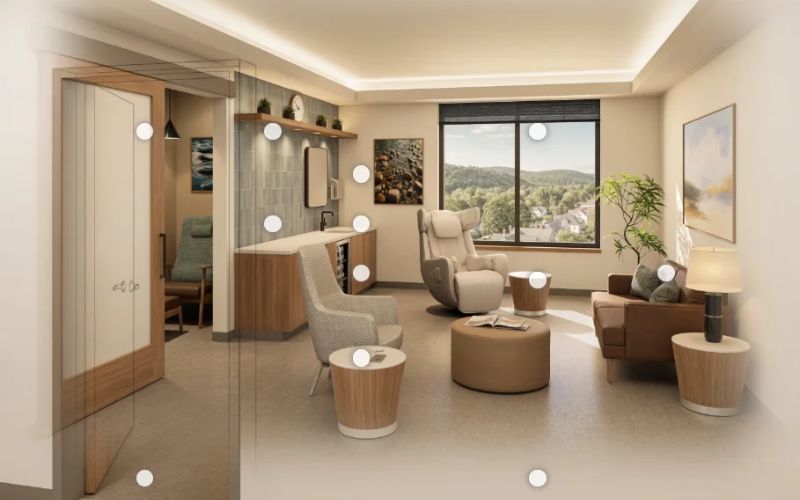
Well-designed staff respite spaces for restorative breaks are proven to reduce physical fatigue, stress, and compassion fatigue, which are linked to burnout, turnover, and medication errors.
The Center’s newest interactive design diagram presents a variety of evidence-based respite room design options for consideration.
This open-access tool draws upon the research evidence and best practice knowledge, and presents it in a visually dynamic format that supports better design decision-making and improved outcomes.
Visit the diagram.
|
|
|
Upcoming Events
|
|
11/19 9:00 AM PT / 12:00 PM ET, Partner Webinar: Healthcare Furnishings: Making Decisions for Safety and Longevity
12/3 10:00 AM PT / 1:00 PM ET, Webinar: Space Utilization: What Healthcare Designers Need to Know
Save These 2027 Dates
1/8, Conference: 2027 PDC Summit Early Registration Deadline
2/28-3/3, New Orleans, LA, Conference: 2027 PDC Summit
3/2, Conference: 2027 PDC Summit The Center for Health Design Awards Ceremony and Changemaker Keynote
5/20, Workshop: Behavioral & Mental Health Half-Day Workshop
At the 2027 PDC Summit, The Center will present our educational track – Research, Design and Outcomes. Learn about our participation and sessions here.
|
|
|
Opportunities
|
|
Become EDAC Certified... Risk Free!
Are you looking to make 2027 the year you elevate your career, project outcomes and evidence-based design skills?
EDAC certification trains you to use a proven and globally-recognized evidence-based design process to improve – with evidence and research – your project design decisions, work, and health, safety and business outcomes.
Lock in our once-a-year Risk Free Offer – and get an extra year-end bonus – by signing up for the EDAC Exam before the end of 2026.
You’ll save 10%, and have a year to take and pass the exam – including one free retake if needed!
PLUS – sign up by December 31 for some extra holiday cheer: 10% off study guides to earn your CEUs. Join over 3,000 EDAC-certified professionals worldwide.
Learn more and register.
|
|
|
|
JOIN US AT THE 2027 PDC SUMMIT
 |
|
CHD members save $400 off full four-day Summit registration through January 8, 2027.
The Center for Health Design is the Strategic Educational Collaborator and Supporting Organization for the PDC Summit | The International Summit & Exhibition on Health Facility Planning, Design & Construction.
At the 2027 PDC Summit The Center will produce and present a 28-session educational track – Research, Design and Outcomes –featuring recent work from The Center’s research team; Environment Networks; the HERD Journal, and other familiar and new healthcare design industry leaders.
Sponsored by Mohawk Group and Momentum Textiles & Wallcovering.
Preview The Center’s 28-session learning track & register here.
|
|
|
|
|
 |
 |
 |
|
Balancing Security, Privacy and Wellness in Healthcare
|
|
Healthcare design presents an operational challenge: facilities must maintain security, staff sightlines, and safety protocols without creating an intimidating, institutional environment. Incorporating human-centered design principles allows project teams to prioritize natural light, open sightlines and biophilic elements while meeting stringent physical safety standards. Evidence consistently shows that human-centered spaces lower stress and support healing for both patients and healthcare workers.
HC+O News, read more...
|
|
|
Sensory-Informed Design for Behavioral Health Spaces
|
|
Human-centered design invites us to think beyond function and deeply examine how the built environment makes us feel. Acoustics, lighting, materiality, color, and scale create stimuli that can directly impact how a space is perceived and experienced. Phenomenology offers one framework for sensory-informed design, helping designers consider how behavioral healthcare environments are interpreted emotionally and psychologically.
I+S Design, read more...
|
|
|
Designing for Longer Lives: Why Aging Is an Architectural Question
|
|
For much of modern history, aging has been treated as a problem for medicine, social care, and public policy. Hospitals, nursing homes, rehabilitation centers, and specialized housing have become the familiar architectural responses to an aging population. Yet this approach overlooks a more fundamental question: what if the greatest challenge of aging is not simply how to care for older people, but how to design environments in which growing older does not mean gradually losing access to everyday life?
Parametric Architecture, read more...
|
|
|
Lessons from Four Decades of Cancer Care Design
|
|
When I began my career in healthcare architecture over 40 years ago, a cancer center was defined almost entirely by its equipment. The linear accelerator vault dictated the floor plan. The infusion chair determined the room. The patient, and everyone who loved them, fit in around the edges. That world no longer exists. The advances in cancer treatment over the past four decades have been staggering, and they have forced a parallel revolution in how we design.
Building Design + Construction, read more...
|
|
 |
|
ABOUT US
For over 30 years the non-profit Center for Health Design has led and empowered current and future healthcare owners, clinicians, architects, designers, product & solution providers and other stakeholders in an industry-wide endeavor to maximize health through informed design.
By providing research, education and community-building to over 25,000 professionals worldwide, The Center drives measurable improvements in health, safety and business outcomes through evidence-based design of the built environment. Explore The Center’s resources, tools and learning opportunities at www.healthdesign.org.
© 2026 The Center for Health Design
|
|
|
|